
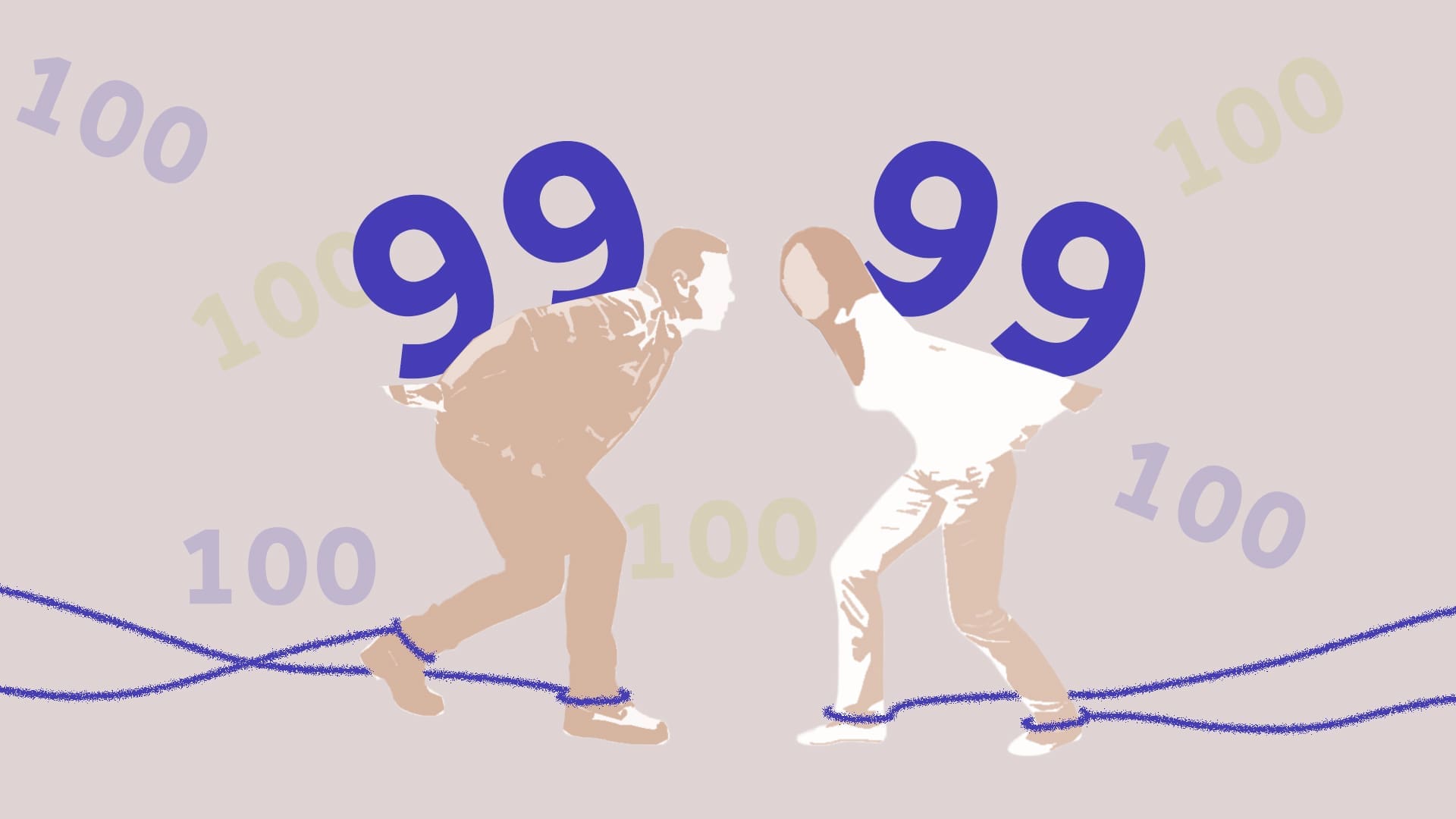

A 99 percent average is no longer enough to guarantee Iraqi students a place in medical school. The sharp rise in grades has sparked a debate: Have students become smarter and more academically capable, or is there something wrong with the examinations and grading system?
The story began in 2020, amid the COVID-19 pandemic and the aftermath of the Tishreen protests, when Iraq’s Ministry of Education was forced to remove portions of the curriculum and postpone examinations to ease the burden on students. What began as a temporary measure, became an annual practice. Students continued demanding curriculum reductions, while the ministry repeatedly responded by adjusting examinations’ schedules. This happened again in April 2026, when the ministry announced the examinations’ timetable, only to revise it three days later following objections from teachers and students.
Although examinations eventually returned to their usual June schedule, with only very limited reductions to the curriculum, grades continued their meteoric rise. The upward trend began in 2020 and continued through 2021, 2022, and 2023, before climbing even higher in 2024 and 2025, with no signs of slowing down. The situation stood in stark contrast to the reality of 2017, for example.

This has prompted many students to repeat an entire academic year, not necessarily to deepen their understanding, but to concentrate on memorising previously used questions in the hope of achieving perfect scores.
99 percent is not enough
The contradiction reached its peak in 2025, when medical colleges closed their doors to students who had achieved averages of 99 percent. The minimum admission average had reached 99.57 percent, forcing these high-achieving students to turn to private universities.
This raises a puzzling question: How can grades continue to rise so dramatically while students are still demanding curriculum reductions and examinations postponements? The answer lies in the nature of the examinations themselves. In recent years, examination questions have increasingly consisted of familiar, recycled formats, allowing students to achieve perfect scores simply by memorising answers and practising them repeatedly, without necessarily developing a deeper understanding of the material.
This repetition has effectively erased the distinction between students who genuinely understand the subject matter and those who rely on memorisation, artificially inflating grades.

The problem becomes particularly clear when comparing mathematics examinations across different years. In the 2018, for example, one question required students to recall and apply mathematical principles they had studied in the fifth preparatory grade. Such questions, which tested students’ ability to think critically and connect concepts, were absent from the 2026 examinations, replaced by straightforward problems that could easily be memorised.
The value of these more challenging questions lies in their ability to distinguish students who genuinely understand mathematical concepts and can connect previous knowledge with new material from those who merely memorise formulas and forget them as soon as they finish the exam.
The 2026 mathematics exam largely reproduced problems from textbooks and previous years’ examinations. According to the figures, 110 out of a total of 155 available marks were allocated to questions that matched textbook exercises word for word. The remaining questions were drawn from previous examinations, with only minor changes to the numbers.
Pre-Packaged Solutions
The growing availability of online lessons and digital study guides since 2020 has further compounded the problem. Although these resources have made educational materials freely accessible to everyone, they have also accustomed students to ready-made answers, undermining their ability to think critically and analyse problems independently.
The problem with the curricula themselves lies in their excessive length and unnecessary content rather than the complexity of their ideas. Overloaded textbooks force students to memorise information quickly to finish the material before examinations, instead of giving them the opportunity to understand and absorb what they are learning.
Education in today’s world is no longer about filling students’ heads with information. It is about training their minds to think critically, solve problems, and work collaboratively. Likewise, integrating technology into education should mean more than relying on condensed revision materials and ready-made solutions. Technology should be used to support research and equip students with practical skills that prepare them for the labour market and benefit them in everyday life. The goal should be to develop students who actively participate, investigate, and ask questions, rather than simply listen.
For all these reasons, rising grades cannot be taken as evidence of exceptional academic ability or improvements in teaching. Instead, they are a clear consequence of an education system that encourages rote memorisation and reproducing information on examination papers at the expense of genuine understanding and analysis.
The Turn to Private Medical Colleges
Iraqi MP Adel al-Rikabi sparked a heated debate when he publicly addressed the growing number of students achieving perfect scores, pointing to repeated examination questions and suspicions of question leaks. His remarks divided opinion across social media. Some students reacted angrily, viewing his comments as a dismissal of their hard work and effort. Others agreed with him, interpreting his statement as an acknowledgement of serious flaws undermining the integrity of the examination system.
At the same time, grade inflation is closely linked to the rapid expansion of private universities. A difference as small as 0.01 percentage points can now be enough to deny a high-achieving student admission to a public medical college, effectively pushing them towards private institutions.
The development of private medical colleges began in September 2017, when Al-Ameed University received the first licence to establish one. Expansion proceeded cautiously until 2022, under strict requirements that included the availability of teaching hospitals. Other institutions, including Warith Al-Anbiyaa University, Al-Kafeel University, and Al-Ayen University, subsequently joined the sector.
By 2024, however, expansion had accelerated into a wave of new medical colleges, raising concerns about the growing number of medical graduates. Under pressure from the Iraqi Doctors Syndicate and Parliament, the government took a decisive step in July 2024, banning the establishment of any additional medical colleges.
In a further attempt to regulate educational quality, the Council of Ministers introduced strict requirements for private medical colleges in late 2025. These included requiring colleges to operate teaching hospitals for practical student training and introducing a unified assessment examination alongside public universities to evaluate students’ academic standards.
Currently, only seven private universities are officially recognised as offering medical degree programmes: Al-Ameed, Warith Al-Anbiyaa, Ashur, Al-Mustaqbal, Al-Sibtain, Al-Kafeel, and Al-Ayen.
But the crisis has not been confined to private education. It has also extended into parallel education programmes within public universities themselves. As grades soared after 2020 while the number of tuition-free places remained unchanged, thousands of high-achieving students found themselves unable to secure places in public medical and engineering colleges. They were consequently forced to pay tuition fees to obtain places through the parallel education system.
This shift transformed parallel education from a relatively limited alternative before 2020 into a major admissions pathway attracting tens of thousands of students annually. In some years, more than 35,000 students applied, with approximately 25,000 securing admissions.
Academic excellence alone was no longer enough. Paying for a university place became an almost unavoidable consequence of an admissions system unable to accommodate the very grades it had helped inflate.
Paying tuition fees through parallel education became a quicker way for students to avoid repeating an entire academic year. Addressing this situation requires a comprehensive response involving both the Ministry of Education and the Ministry of Higher Education and Scientific Research, as the problem begins in schools and ends at university admissions.
Solutions for the Ministry of Education
The solution begins with the Ministry of Education establishing a fixed academic calendar that remains consistent throughout the year, protecting students from uncertainty and last-minute changes.
The next crucial step is to reform ministerial examinations by introducing questions that assess understanding, analysis, and problem-solving abilities, allowing students with stronger academic skills to distinguish themselves rather than relying on recycled question formats that produce identical scores. This should be accompanied by curriculum reform that prioritises critical thinking skills while taking into account the realities and resources of Iraqi schools.

The Ministry of Higher Education, meanwhile, must move away from relying exclusively on grades as the determining factor in university admissions. Students’ futures should not depend on tiny fractions of a percentage point. Instead, specialised entrance examinations and interviews could assess applicants’ abilities and motivation, helping determine whether they are suited to studying medicine or other majors before being offered a place.
Grade inflation is not evidence of a sudden surge in academic brilliance. Rather, it is the product of an education system that rewards memorisation while neglecting genuine understanding. Former Minister of Higher Education Naim al-Aboudi acknowledged this problem, pointing to the gap between students’ grades and universities’ admission capacities.
Intense competition has driven minimum admission requirements to unprecedented levels, even at private colleges, where applicants must achieve averages of at least 95 percent for general medicine and 85 percent for dentistry and pharmacy.
Reversing this trend requires a fair assessment system that recognises students as individuals with distinct abilities, rather than reducing them to numbers on a grade report.


